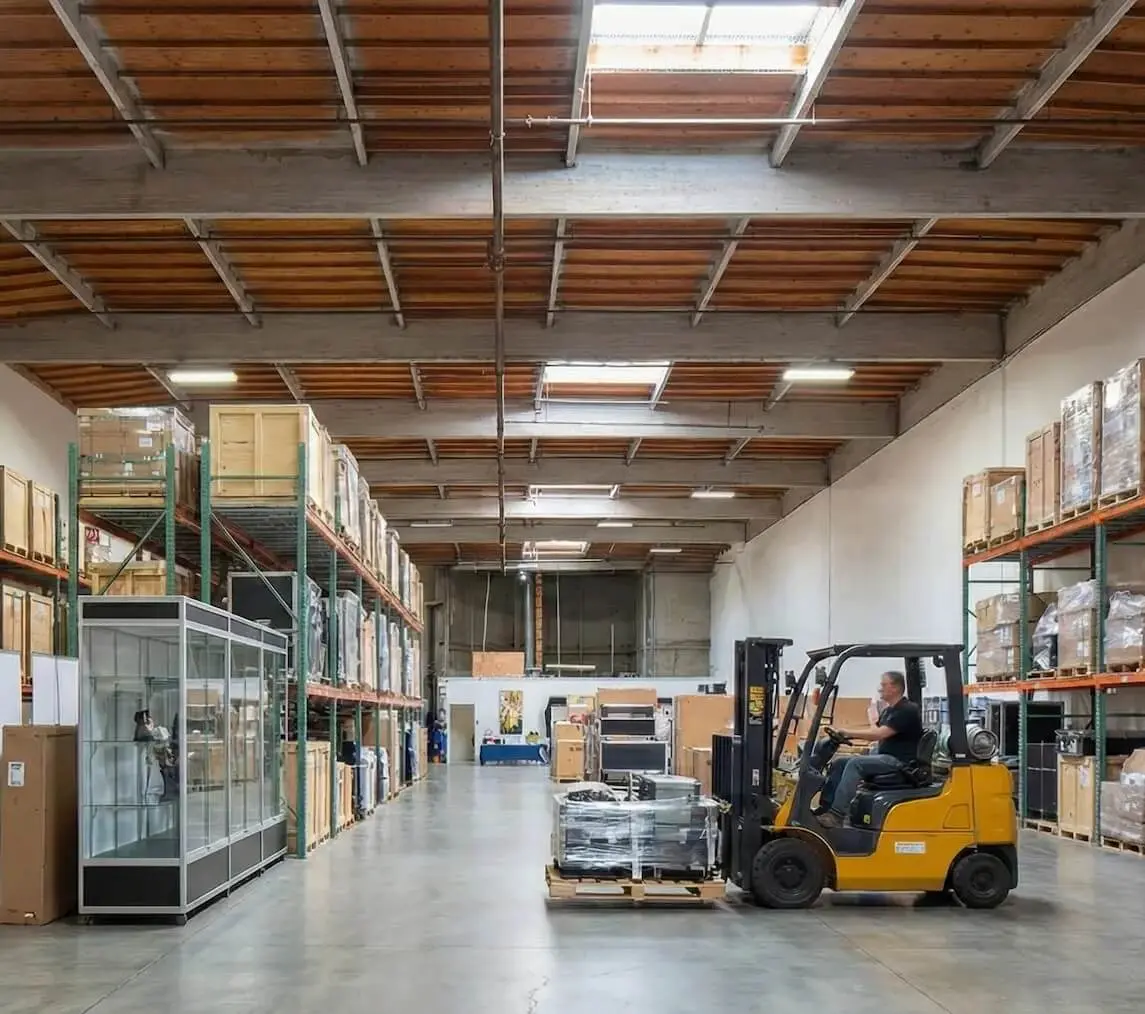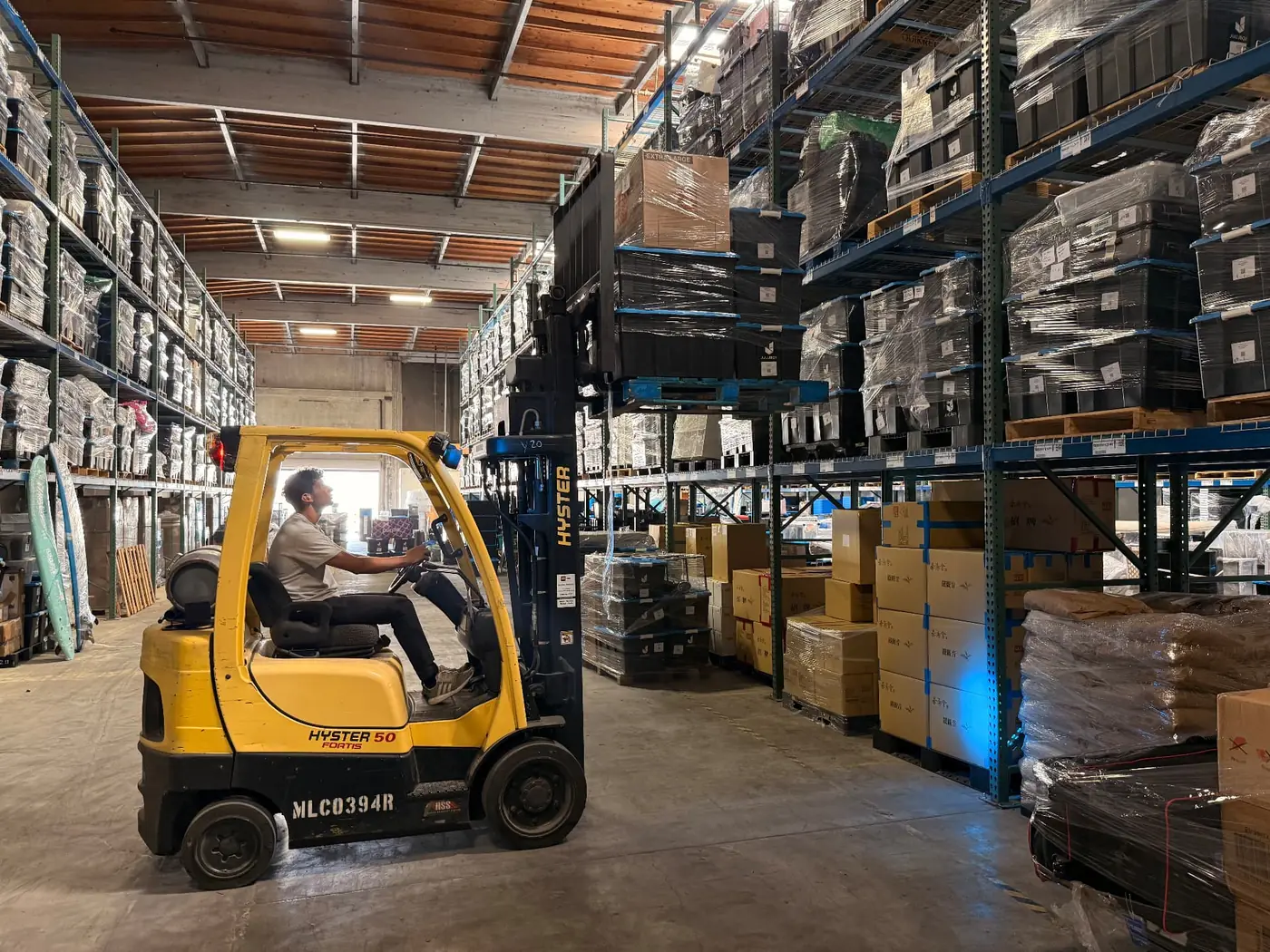
Managed trade show booth storage starts around $295 per month for the first event kit (pallet position), plus $125 per month for each additional kit. Exhibit houses typically charge by the square foot and bundle storage into fabrication contracts, while self-storage units run $100–$350 per month before you count your team’s packing and freight hours. Here’s the full breakdown for 2026.
The monthly storage rate rarely tells the whole story. Some providers quote space only. Others add handling, account management, or weight minimums. The useful comparison is the annual cost of keeping the booth and every supporting event asset organized, show-ready, and moving on schedule.
The four ways to store a booth – and what each really costs
Exhibit house storage
An exhibit house designs, builds, repairs, and often stores custom booths. Storage may be billed by occupied floor space, cubic volume, crate count, or as part of a larger exhibit-management contract.
For a compact 10x10 booth, the full storage program commonly lands around $250–$600 per month after minimums, account management, and handling. Larger modular or custom exhibits can run $600–$1,500 or more per month when they involve multiple crates, oversized components, inspections, repairs, and pre-show preparation.
This can be worthwhile when the same company built the exhibit and maintains it between shows. The main limitation is scope. Many exhibit houses focus on the exhibit property they fabricated. Swag, literature, uniforms, product samples, spare technology, and shipments from unrelated vendors may require another arrangement or added fees.
That can leave the booth professionally stored while the rest of the event program remains scattered across an office, employee garages, and self-storage. Teams comparing trade show booth storage should look at the full exhibit-house contract, not only its warehouse line item.
Show contractor or general service contractor storage
Freeman, GES, and other general service contractors are essential at the show. They unload freight, move it to the booth, store empty containers during the event, and reload outbound shipments.
Post-show or show-to-show storage is usually billed by weight. Charges can include returning freight to a warehouse, monthly storage, and handling when it leaves. Public rate cards commonly use a 1,000-pound minimum, so a lighter booth may still be priced as if it weighs half a ton.
For a small exhibit program, storage-related charges can start in the hundreds after one show. A four-show year commonly reaches about $3,000–$7,000 once warehouse returns, monthly minimums, and repeated handling are included. Special handling, uncrated freight, late arrivals, overtime, and off-target deliveries can push the total higher.
This service is built to move freight through a specific show, not to run an ongoing inventory program. Access between events may be limited, item-level visibility is uncommon, and returned freight may take several business days to become available.
Self-storage plus DIY logistics
In major markets, a unit large enough for a standard booth kit commonly runs about $100–$350 per month. The visible rent is straightforward. The hidden work is not.
Your team becomes the receiving department, inventory manager, packing crew, and freight coordinator. Someone must meet deliveries, move road cases, locate the correct graphics, count giveaways, buy supplies, create labels, document damage, and put everything away after the event.
For four shows a year, those tasks can consume 30–60 staff hours, sometimes more. At a fully loaded employee cost, the labor can equal or exceed the unit rent.
Self-storage can work for one lightweight display and a small event schedule. It becomes less practical when multiple vendors ship separately, pallet access is needed, inventory changes frequently, or no one clearly owns the process.
Independent managed storage
Independent managed storage combines warehouse space with the operational work that self-storage leaves to your team.
Juujbox starts at $295 per month for the first event kit (pallet position), plus $125 per month for each additional kit. The plan includes receiving and cataloging, a photo-based inventory portal, and up to 12 deployments per year. Carrier shipping is billed separately. Customers can use their own carrier accounts, or Juujbox can compare available options and coordinate the best practical rate for the shipment.
The bigger difference is what can be received. Juujbox can accept the booth from an exhibit house, graphics from a printer, swag from a promotional supplier, uniforms from an apparel vendor, and materials from your own offices. Everything can be cataloged together and prepared as one show-specific deployment.
That makes managed booth storage useful for the entire event kit, not only the structure. Teams with props, signage, branded materials, and other non-booth assets can also review Juujbox event storage.
The costs nobody puts on the invoice
Team hours spent packing and inventorying
A marketing manager’s time is expensive. When that person spends an afternoon searching for a monitor mount, rebuilding a packing list, or driving to a storage unit, the company is paying professional labor rates for warehouse work.
Multiply that across several shows, then add the time spent coordinating separate shipments from the exhibit house, printer, swag supplier, and office.
Damage discovered at the next show
A cracked counter, missing power supply, bent frame, or creased graphic is manageable when found after the last event. It becomes a rush order when discovered during move-in.
A proper return process should document condition, identify missing pieces, and leave time for repairs or replacement.
Fees caused by the wrong shipping window
The advance warehouse accepts freight during a defined period. Ship too early and storage fees may apply. Ship too late and you may face late-to-warehouse charges, direct-to-show handling, or expedited transportation.
The difference is explained in Advance Warehouse vs. Direct to Show. The lowest-cost path is usually planned early enough to use standard ground service and meet the published receiving window.
Reprinting items you already own
Teams reorder banners, table throws, cables, signs, and promotional materials because no one can confirm what is stored. The invoice looks like a marketing expense, but the root problem is poor inventory visibility.
Coordinating multiple vendors
A show may involve a booth builder, printer, promotional products company, apparel supplier, product team, and event agency. Receiving those materials at one managed hub creates time to verify quantities, resolve problems, and combine the shipment before it reaches the venue.
A worked example
Consider a team with a standard 10x10 booth, one or two road cases or crates, graphics, cables, and several boxes of swag. It attends four shows per year.
The table estimates the annual cost of the storage method. Carrier transportation, show-site material handling, installation labor, repairs, and graphic production are excluded because they can apply under every option.
| Storage option | Estimated annual cost | What is included | Main limitation |
|---|---|---|---|
| Exhibit house | Typically $4,000–$9,000 | Booth storage, account management, handling, and some exhibit preparation | Other event materials may be outside the contract |
| Show contractor | Commonly $3,000–$7,000 | Return-to-warehouse handling and weight-based storage | Weight minimums, repeated fees, and limited inventory visibility |
| Self-storage plus DIY | Roughly $3,000–$9,000 | Unit rent, supplies, local trips, and 30–60 hours of internal labor | Your team performs every logistics task |
| Juujbox Standard Event Kit | $3,540 | 12 months of storage, receiving and cataloging, inventory portal, and up to 12 deployments | Carrier shipping is separate; additional kits cost $125 per month each |
Self-storage may have the lowest visible invoice, but often stops being the lowest-cost choice after labor and duplicate purchases are counted. Exhibit houses offer valuable technical expertise but may not consolidate unrelated assets. Show contractor storage is convenient in specific situations, but weight minimums and repeated handling make it difficult to budget.
Juujbox is designed to keep the storage and management cost predictable while bringing the booth, graphics, giveaways, literature, replacement parts, and vendor-direct deliveries into one system.
How to cut your booth storage cost
Consolidate to one hub
Every extra storage location creates another pickup, inventory list, and chance of sending an incomplete kit. Keep the booth and supporting materials together whenever possible.
Send vendors to the hub
Ask the printer, swag supplier, apparel vendor, and exhibit house to ship to the same receiving location. This gives the storage team time to verify and combine everything.
Store the kit show-ready
Label cases by contents and use. Keep cables, tools, replacement hardware, and setup instructions with the component they support.
Protect the advance-warehouse deadline
Build the schedule backward from the receiving deadline. Regional ground service is usually more efficient than waiting until the final week. Customers can use their own carrier account or ask Juujbox to compare and coordinate carrier options.
Remove what you no longer deploy
After each show, identify unused or obsolete graphics, literature, furniture, and giveaways. A cleaner inventory costs less to store and is easier to deploy correctly.
For a predictable managed option, see booth storage pricing. If you also need the booth shipped to the show, see trade show booth shipping.
Frequently asked questions
Is exhibit house storage worth it?
It can be when the exhibit house designed the booth, maintains it between shows, and manages a complex custom build. Compare the complete annual program, including storage, handling, account management, inspections, and prep. Confirm whether it will also accept swag, literature, products, and shipments that were not part of the booth build.
How much does it cost to store a 10x10 booth?
A self-storage unit may cost about $100–$350 per month in a major market, without receiving, inventory, packing, or deployment labor. An exhibit-house program for a compact 10x10 commonly totals about $250–$600 per month after minimums and management fees. Juujbox costs $295 per month for the first event kit (pallet position), plus $125 per month for each additional kit.
Can I store a trade show booth in a self-storage unit?
Yes, especially for a lightweight display and a small event schedule. Confirm that the facility allows business inventory, carrier deliveries, and the access your cases require. Someone on your team will still need to receive, count, pack, label, ship, and inspect everything.
What does show contractor storage cost?
Show contractor storage is commonly billed by weight with minimum charges, plus warehouse-return and retrieval handling. Public rate structures can price a shipment at a 1,000-pound minimum even when the booth weighs less. For a four-show program, storage-related contractor charges can commonly total about $3,000–$7,000 before carrier transportation, standard show-site drayage, labor, or surcharges.
One place for every event asset
A booth storage program should do more than keep crates off the office floor. It should give your team one place to receive vendor shipments, see what is available, prepare the right kit, and deploy it without rebuilding the process for every show.
Juujbox manages the booth and the materials around it, including graphics, swag, samples, uniforms, literature, and spare hardware. See Juujbox's rate card or ship the booth to your next show.